CBSE Class 10 AI Syllabus 2025-26: The Central Board of Secondary Education introduced Artificial Intelligence (AI) into its CBSE Class 10 syllabus for the 2025-26 academic year. This significant step recognises the increasing importance of AI in our rapidly evolving world. By introducing AI concepts early on, CBSE aims to prepare students for the future job market, where AI skills will be highly valuable. Learning about AI encourages students to think critically, analyse information, and develop creative solutions to real-world challenges. We have provided students CBSE Class 10 AI syllabus 2025-26 below.
Objective of the Course
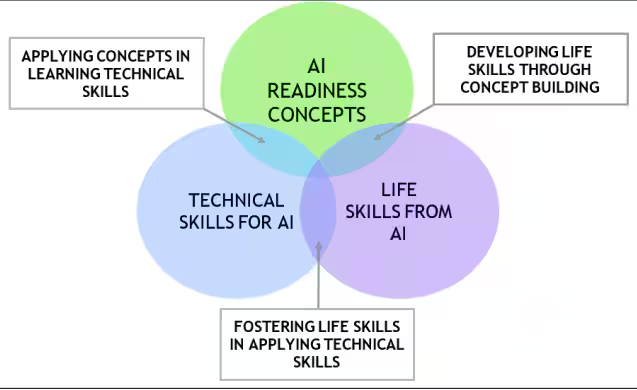
The objective of this module/curriculum – which combines both Inspire and Acquire modules is to
develop a readiness for understanding and appreciating Artificial Intelligence and its application in our
lives. This module/curriculum focuses on:
- Helping learners understand the world of Artificial Intelligence and its applications through
games, activities and multi-sensorial learning to become AI-Ready. - Introducing the learners to three domains of AI in an age-appropriate manner.
- Allowing the learners to construct meaning of AI through interactive participation and engaging
hands-on activities. - Introducing the learners to AI Project Cycle.
- Introducing the learners to programming skills – Basic python coding language.
Learning Outcomes
Learners will be able to
- Identify and appreciate Artificial Intelligence and describe its applications in daily life.
- Relate, apply and reflect on the Human-Machine Interactions to identify and interact with the
three domains of AI: Data, Computer Vision and Natural Language Processing and Undergo
assessment for analysing their progress towards acquired AI-Readiness skills. - Imagine, examine and reflect on the skills required for futuristic job opportunities.
- Unleash their imagination towards smart homes and build an interactive story around it.
- Understand the impact of Artificial Intelligence on Sustainable Development Goals to develop
responsible citizenship. - Research and develop awareness of skills required for jobs of the future.
- Gain awareness about AI bias and AI access and describe the potential ethical considerations
of AI. - Develop effective communication and collaborative work skills.
- Get familiar and motivated towards Artificial Intelligence and Identify the AI Project Cycle
framework. - Learn problem scoping and ways to set goals for an AI project and understand the iterative
nature of problem scoping in the AI project cycle. - Brainstorm on the ethical issues involved around the problem selected.
- Foresee the kind of data required and the kind of analysis to be done, identify data requirements
and find reliable sources to obtain relevant data. - Use various types of graphs to visualize acquired data.
- Understand, create and implement the concept of Decision Trees.
- Understand and visualize computer’s ability to identify alphabets and handwritings.
- Understand and appreciate the concept of Neural Network through gamification and learn basic
programming skills through gamified platforms. - Acquire introductory Python programming skills in a very user-friendly format.
Scheme of Studies
This course is a planned sequence of instructions consisting of units meant for developing employability
and vocational competencies of students of Class IX opting for skill subject along with other education
subjects. The unit-wise distribution of hours and marks for class IX & X is as follows:
This page provides a comprehensive overview of the latest CBSE Class 10 Artificial Intelligence (AI) syllabus for the 2025-2026 academic year. The CBSE AI syllabus is under Skill Subject Code 417 and outlines both employability skills and subject-specific skills, offering valuable insights for students and educators. Check the 10th Class AI syllabus below.
SKILLS TO BE DEVELOPED
CBSE 10th Artificial Intelligence 2025-26
| Units | Number of hours for theory and practical | Maximum marks for theory and practical |
|---|---|---|
| PART A – Employability Skills | ||
| Unit 1: Communication Skills-II | 10 | 2 |
| Unit 2: Self-Management Skills-II | 10 | 2 |
| Unit 3: ICT Skills-II | 10 | 2 |
| Unit 4: Entrepreneurial Skills-II | 15 | 2 |
| Unit 5: Green Skills-II | 5 | 2 |
| Total | 50 | 10 |
| PART B – Subject Specific Skills | ||
| Unit 1: Revisiting AI Project Cycle & Ethical Frameworks for AI | 15 | 7 |
| Unit 2: Advanced Concepts of Modelling in AI | 25 | 11 |
| Unit 3: Evaluating Models | 25 | 10- |
| Unit 4: Statistical Data | 28 | — |
| Unit 5: Computer Vision | 30 | 4 |
| Unit 6: Natural Language Processing | 27 | 8 |
| Unit 7: Advance Python | 10 | – |
| Total | 160 | 40 |
| PART C – Practical Work | ||
| Practical File with a minimum of 15 Programs | 15 | |
| Practical ExaminationUnit 4: Statistical DataUnit 5: Computer VisionUnit 6: Natural Language ProcessingUnit 7: Advance Python | 15 | |
| Viva Voce | 5 | |
| Project Work / Field Visit / Student Portfolio (Anyone to be done) | 10 | |
| Viva Voce (related to project work) | 5 | |
| Total | 50 | |
| Grand Total | 210 | 100 |
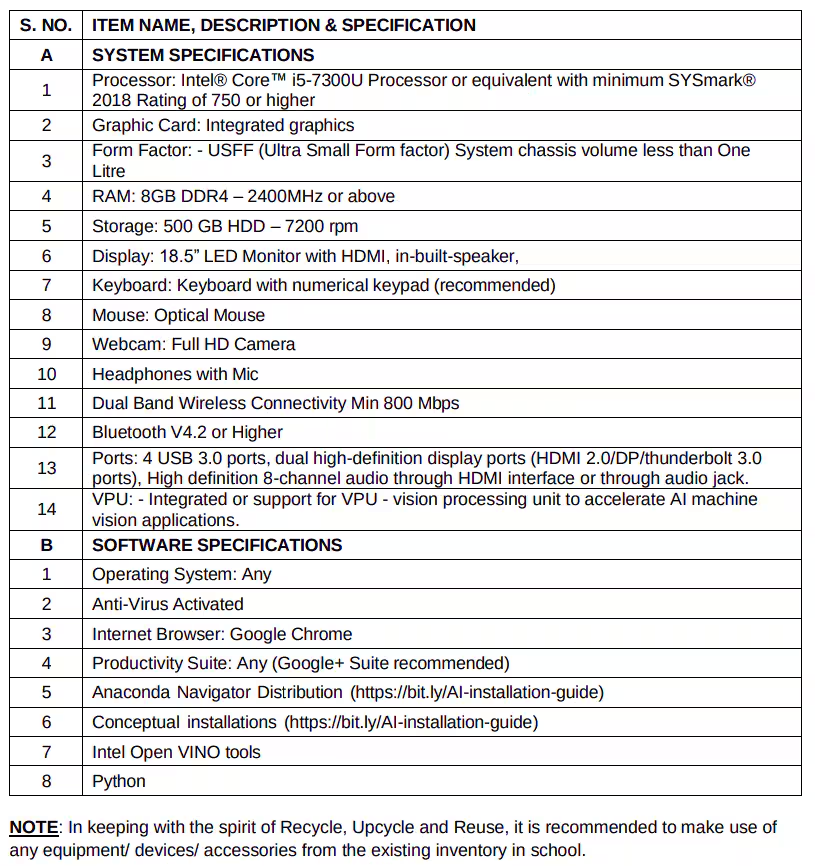
Hardware and Software Requirements for CBSE Class 10 AI Syllabus 2025